
A lot of people who choose PRK start by looking into LASIK. They often find out their corneas are thinner than average, or their job puts their eyes at risk in ways that make a corneal flap less safe.
Photorefractive keratectomy (PRK) reshapes the front surface of the cornea instead of working under a flap. This difference affects comfort, healing, and how long recovery takes.
If your eye doctor suggests PRK, these eight questions can help you prepare. They cover what many patients wish they had asked before their surgery.
1. Am I a Better Candidate for PRK Than for LASIK?
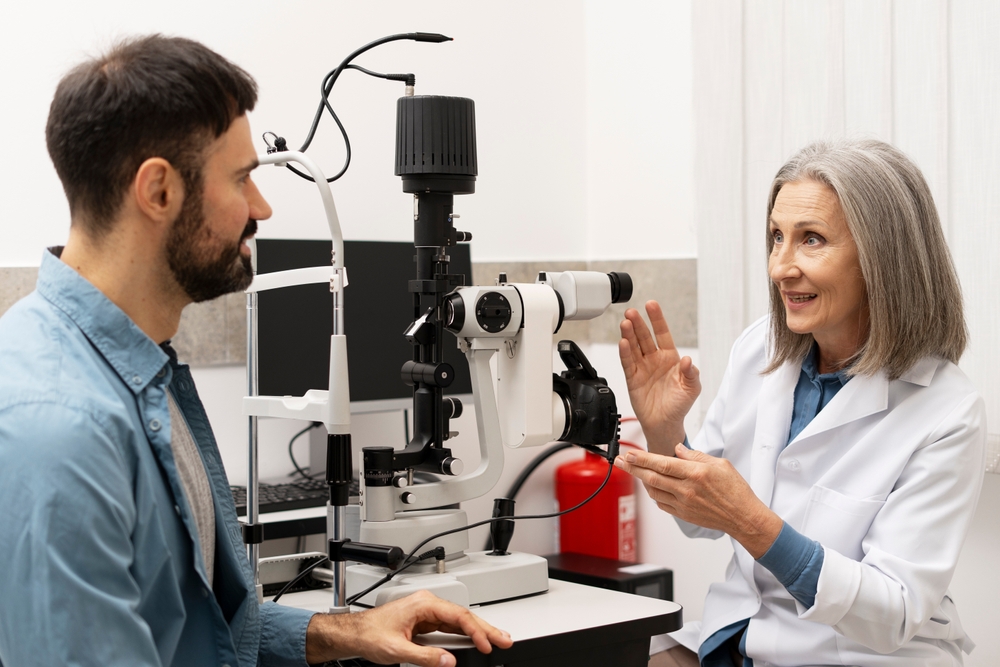
Anyone who qualifies for LASIK could potentially have PRK, but the reverse is not always true. Because PRK creates no flap, it spares corneal tissue, which opens the door for some patients who were told LASIK was not an option. Thin or slightly irregular corneas fall into that group. So do people in high contact professions. Military members, law enforcement, and martial artists often choose PRK specifically because there is no flap to damage if they take a hit to the face.
Ask your doctor about your specific measurements instead of just accepting a general recommendation. Corneal thickness and surface shape are checked before any laser procedure, and these results matter more than personal preference.
You should also ask about the quality of your tear film. Surgeons check for dry eye and often treat it before surgery, because a dry eye surface can affect both your test results and how quickly you heal.
If you have not had an evaluation yet, a quick self-test can help you see if you might be a good candidate for LASIK.
2. Will PRK Correct My Astigmatism?
For most people, the answer is yes. Astigmatism rarely keeps someone from having laser vision correction, and the treatable ranges for nearsightedness, farsightedness, and astigmatism are the same for PRK and LASIK. Bring your current prescription to your consultation so you can find out where you fit in those ranges.
3. What Will the First Week Actually Feel Like?
The procedure does not hurt because your eyes are numbed the whole time.
The first four to six hours after surgery can be uncomfortable, depending on your pain tolerance. With PRK, the surgeon removes the top layer of the cornea instead of lifting a flap, and this layer needs to grow back before your eye feels normal again.
Ask what you will go home with, how often to use each drop, and who to call if the discomfort runs past what you were told to expect. Patients who know what the second and third day feel like in advance tend to have a much easier week than patients who do not.
4. When Can I Drive, Work Out, and Get Back to My Job?

You will not be able to drive yourself home after the procedure, so make sure to arrange a ride ahead of time.
Doctors recommend resting for 24 to 48 hours after surgery to let your eyes heal. Many people feel ready to get back to their usual routines in four to five days, and most normal activities, like driving and working, can start again within a week.
If your job involves dust, wind, bright lights, or long hours at a screen, mention this during your consultation. Ask your doctor for a recovery timeline that fits your specific work conditions.
Be sure to ask about when you can return to the gym, go swimming, or play any contact sports.
5. How Long Until My Vision Stabilizes?
The laser treatment applied during PRK is the same as the one used in LASIK, so the destination looks similar. Most patients reach 20/20, and nearly all reach 20/40 or better. The difference is pace. Vision sharpens more gradually with PRK because the epithelial cells need time to heal, and recovery differs from LASIK in ways worth reading about beforehand. Ask your surgeon for a week-by-week picture so a blurry day three does not alarm you.
6. What Risks Are Specific to PRK?
The risks are similar to LASIK, but there are a few differences. Since PRK does not create a flap, it avoids all flap-related complications. However, the top layer of the cornea must grow back, and in a small number of cases, it does not heal perfectly clear. This is called haze, and it can limit vision compared to glasses or contacts.
As with any surgery, infection is possible. Using antibiotic eye drops as directed before and after PRK greatly reduces this risk.
Ask your surgeon to explain the specific risks for your eyes and prescription, rather than just giving a general list.
7. Will I Still Need Glasses Later On?
Most people do not need glasses for distance after PRK, but everyone is different. Patients between 18 and 40 usually do not need prescription glasses after surgery. After age 40, the eye’s natural lens becomes less flexible, so reading glasses are often needed. This is called presbyopia, and it happens to everyone, even after laser surgery. If you want to avoid reading glasses, ask about monovision during your consultation, not after your eyes have healed.
It is also important to remember that refractive surgery cannot prevent other vision changes that may happen later in life due to other parts of the eye.
8. What Does PRK Cost, and What Is Included in That Number?

The price depends on which pre- and post-operative package you choose, and each has its own cost. A single quote usually does not include everything. You will get a detailed cost sheet at your free evaluation.
Here are three things to ask about during your cost discussion:
- How many follow-ups visits the package covers
- What happens if an enhancement procedure is needed later
- Whether CareCredit financing fits your monthly budget
Wondering whether PRK is the right procedure for your eyes? Schedule an appointment at Black Hills Regional Eye Institute in Rapid City, SD.